

Vault Evaluation Strategy
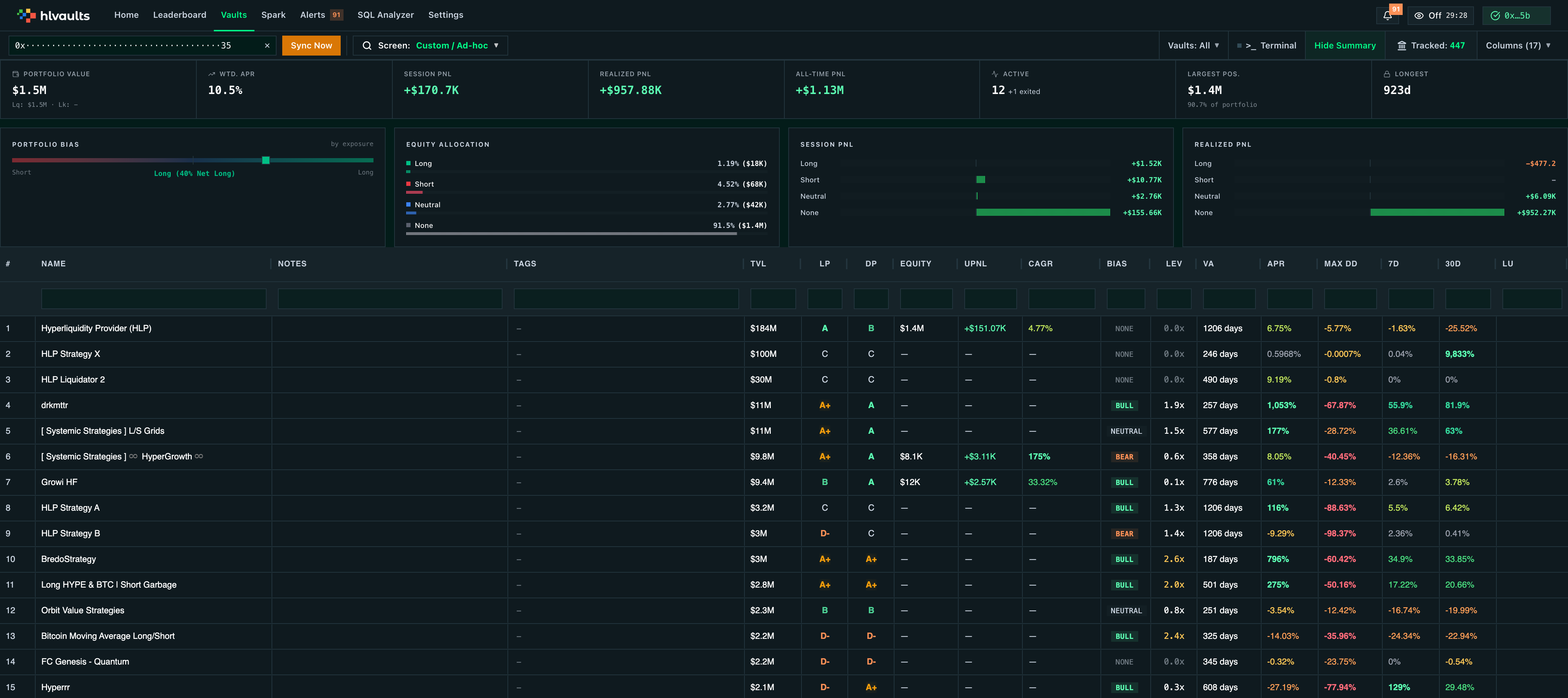
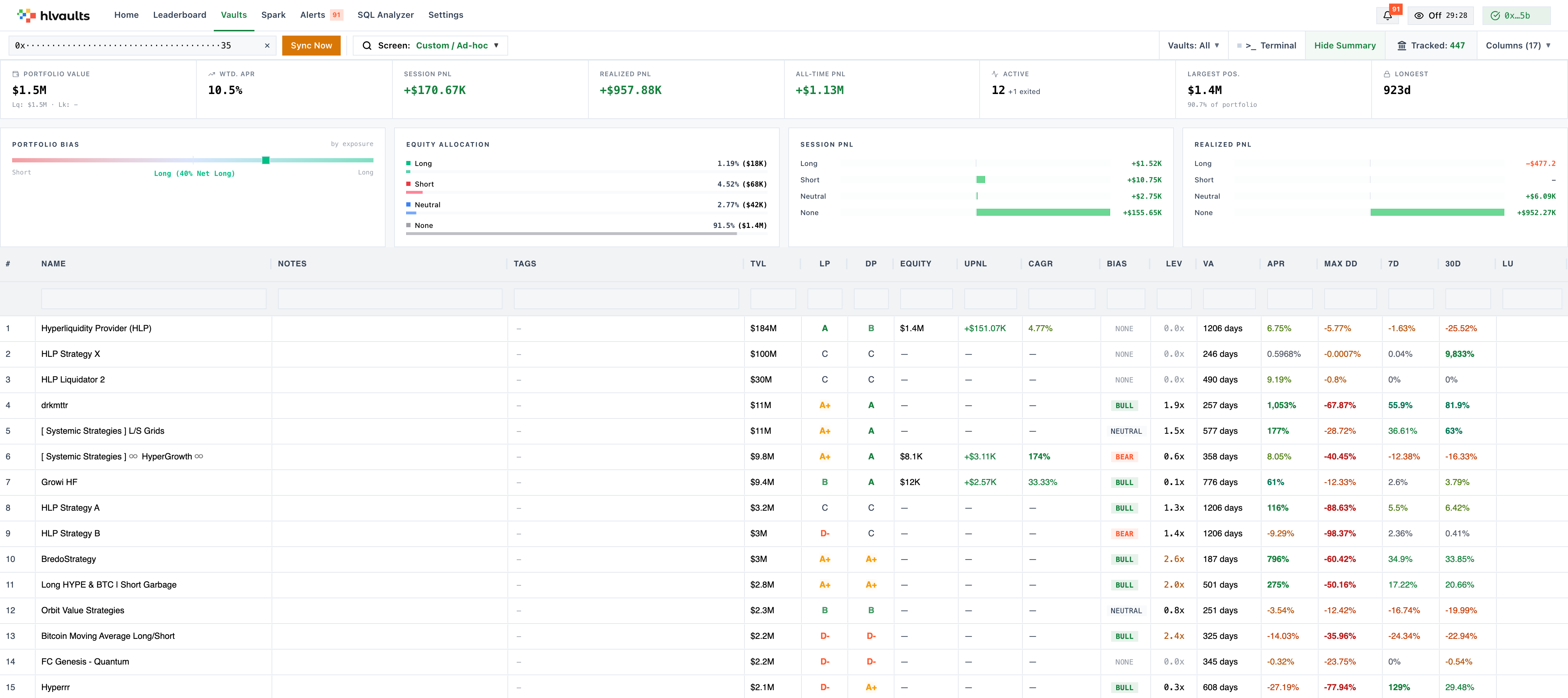
Every vault tells a story. The question is whether you’re reading it right. This guide lays out a repeatable process — from defining your requirements to managing a portfolio across multiple vaults. Treat it as a framework, not a checklist.
What Are Your Baseline Criteria?
Section titled “What Are Your Baseline Criteria?”The leaderboard is tempting to dive straight into. Resist that urge. Start by writing down what matters to you.
| Factor | What to consider |
|---|---|
| Risk tolerance | Can you handle 30% drawdowns? Do you prefer steady single-digit returns? |
| Time horizon | Short-term (weeks) or long-term (months+) |
| Capital size | Larger deposits may need vaults with higher TVL and liquidity |
| Bias preference | Long, short, neutral, or volatility |
| Fee tolerance | Willing to pay high commission for strong returns, or prefer low fees for baseline exposure |
Once you have answers, turn them into thresholds. For example: “Minimum LP grade B, minimum TVL $100K, max drawdown under 20%.” These numbers become your first filter — everything after that is just narrowing down.
How Do You Screen the Leaderboard?
Section titled “How Do You Screen the Leaderboard?”The Leaderboard is your first pass. Sort by LP grade, DP grade, or APR to surface the strongest candidates. Focus on four columns:
Red flags to watch for
Section titled “Red flags to watch for”- High APR, low TVL. A vault that’s too new or too small to trust with meaningful capital.
- Strong LP, weak DP. The leader may be performing well, but depositors are getting squeezed by fees or poor timing.
- Short track record. Less than 30 days of data isn’t enough to judge consistency.
- Extreme bias with no recent performance to back it up. A vault that’s all conviction and no results.
What to Look for in the Vault Detail
Section titled “What to Look for in the Vault Detail”Click into any vault that passes your initial screen. The Vault Detail page gives you the full picture.
Key performance indicators
Section titled “Key performance indicators”The KPI strip at the top provides a quick health check:
- LP Grade — Has the leader delivered consistently?
- DP Grade — Are depositors actually profiting?
- APR — Does the recent return align with your targets?
- 24h PnL — How volatile are daily returns?
- Drawdown — Has the vault experienced major drops, and how quickly did it recover?
- Age — Older vaults with consistent data carry more weight.
Charts
Section titled “Charts”Each chart tells you something different about the vault’s behavior.
| Chart | What to look for |
|---|---|
| PnL over time | Smooth growth or wild swings |
| TVL over time | Growing TVL suggests depositor confidence |
| Drawdown over time | Frequency and depth of losses |
| APR over time | Consistency versus spikes |
| DP vs LP over time | Are both moving together? |
| Depositor composition | Is one whale dominating? |
Depositor composition
Section titled “Depositor composition”Growth Feature. A vault’s depositor list reveals concentration risk:
- Are deposits distributed across many wallets or concentrated in a few?
- Have large depositors been withdrawing recently?
- A broad base of small depositors is healthier than a handful of whales.
How Does Bias Affect Performance?
Section titled “How Does Bias Affect Performance?”A vault’s bias tells you when it’s built to perform. Match that bias to current market conditions.
- Long-biased vaults — Excel in uptrends. They will drop hard in downtrends.
- Short-biased vaults — Act as a hedge during downturns. They’ll lag when markets rise.
- Neutral vaults — Deliver consistent returns across market regimes. Good core portfolio candidates.
- Volatility-biased vaults — Profit in choppy, range-bound markets. Underperform in steady trends.
The key question: does the vault’s bias align with your market outlook? If you’re bullish but all your vaults are short-biased, something is off.
Leverage Signals and Set Up Alerts
Section titled “Leverage Signals and Set Up Alerts”Signals & Intelligence
Section titled “Signals & Intelligence”★ Pro Pro feature. The Signals & Intelligence tab adds automated analysis to your evaluation:
- Six deterministic signals — Momentum, volatility, bias consistency, drawdown risk, depositor health, and trend strength.
- AI commentary — Natural language analysis of the vault’s current state.
- Ask AI — Ask specific questions like “Has this vault recovered from drawdowns quickly in the past?”
Monitoring alerts
Section titled “Monitoring alerts”Once you’ve identified vaults worth tracking, set up alerts to stay informed without watching the screen constantly.
- APR threshold alerts — Get notified when returns cross your target or minimum.
- Drawdown alerts — Warn you when a vault drops past your risk tolerance.
- New vault alerts — Monitor for new vaults from leaders you follow.
- Grade change alerts — Know when a vault’s LP or DP grade improves or declines.
How Should You Build a Portfolio?
Section titled “How Should You Build a Portfolio?”No single vault is a portfolio. Diversification matters here as much as it does in any other asset class.
| Strategy | Allocation |
|---|---|
| Core holdings | 50–60% in established vaults with strong LP/DP grades and consistent performance |
| Growth positions | 20–30% in newer vaults with higher APR and shorter track records |
| Hedge positions | 10–20% in vaults with opposite bias to your core holdings |
Use the Portfolio view to track your total allocation, net bias exposure, and PnL across all vaults. Revisit your allocations monthly or quarterly — vaults change, and your portfolio should change with them.
What Mistakes Should You Avoid?
Section titled “What Mistakes Should You Avoid?”- Chasing peak APR. The vault with the highest APR today is rarely the best long-term hold.
- Ignoring DP grade. A vault can have an exceptional leader but deliver poor returns to depositors because of fees or execution timing.
- Over-concentrating in one vault. If that single vault drops, your entire portfolio drops with it.
- Skipping the fine print. Always check lockup periods and commission structures before depositing.
- Reacting emotionally to daily PnL. Vaults have good days and bad days. Evaluate over weeks, not minutes.
Summary Checklist
Section titled “Summary Checklist”- Define your risk tolerance and return targets
- Screen the leaderboard against your baseline thresholds
- Evaluate vault detail — KPIs, charts, depositor composition
- Understand vault bias and market fit
- Review signals and AI analysis
- Set alerts for ongoing monitoring
- Diversify across multiple vaults
- Re-evaluate monthly or quarterly