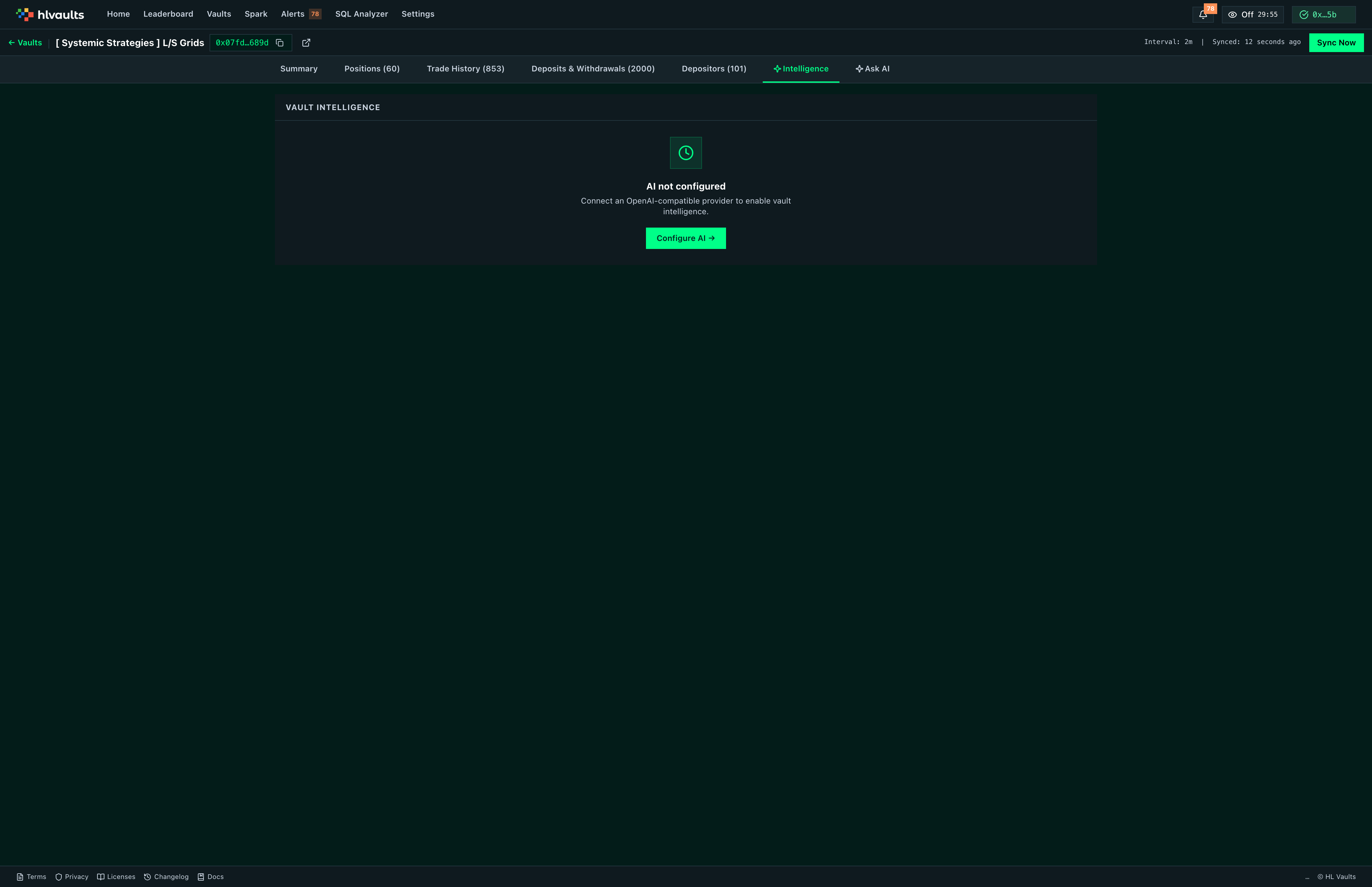
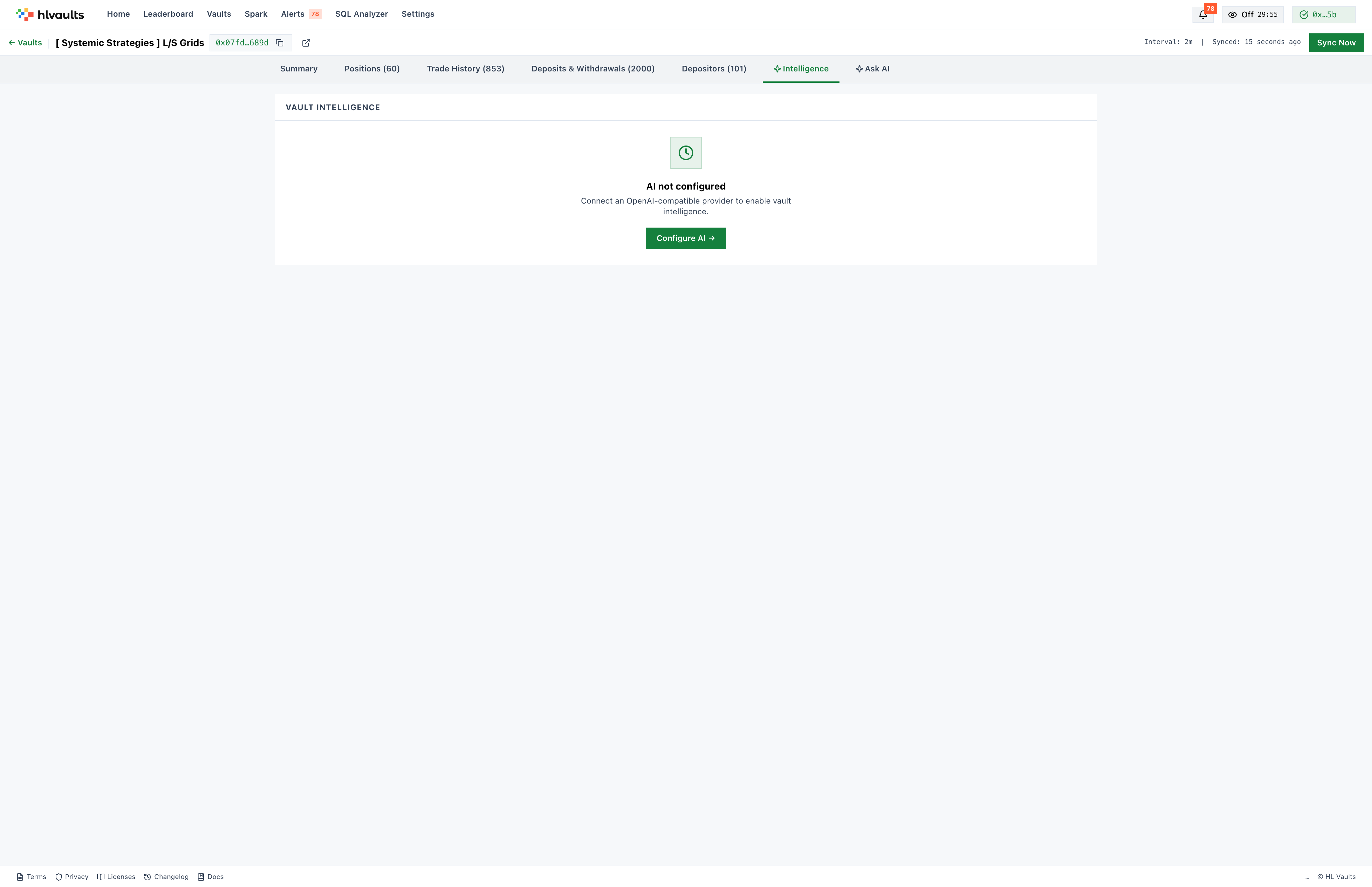
Intelligence
Pro Feature★ Pro
The Intelligence tab brings together quantitative signals and AI-generated analysis for any vault. It’s designed for the second and third passes of evaluation — after you’ve reviewed the fundamentals and want to dig deeper.
For full explanations of each signal type, see the Signals & Intelligence guide.
Quantitative signals
Section titled “Quantitative signals”Seven signal cards deliver structured diagnostics computed from the vault’s trading data, updated on a regular cycle.
| Signal | What it measures |
|---|---|
| Style Fingerprint | Classification of the leader’s trading style — scalper, intraday, swing, or position trader. |
| Leverage Profile | Average and maximum leverage, plus a distribution histogram of leverage used across all positions. |
| Drawdown Recovery | How quickly and reliably the vault recovers from drawdowns. Consistent recoveries suggest disciplined risk management. |
| Depositor Concentration | Herfindahl-Hirschman Index applied to the depositor base. A high score means capital is concentrated among few wallets — a risk factor for large withdrawals. |
| Trading Velocity | How many times the leader has flipped between long and short bias over 30 and 90 days. |
| Cross-Vault Correlations | Pearson R correlation between this vault’s returns and those of other vaults. Vaults that move together reduce your effective diversification. |
| Fill-to-Mark Lag | Median delay between the leader’s fills and the corresponding mark price moves. |
AI analysis
Section titled “AI analysis”AI analysis requires an LLM provider configured in your settings. When enabled, it produces three additional reports:
- Personality Dossier — a qualitative assessment of the leader’s trading psychology, based on their decisions. Not a clinical evaluation, but a framework for understanding their behavioral patterns.
- Return Forecast — a short-to-medium-term outlook. Treat it as directional, not predictive.
- Red Flag Detection — automated risk warnings with severity ratings. Flags patterns that have historically preceded sharp drawdowns or other adverse events.
Data freshness
Section titled “Data freshness”The Intelligence header displays the last-refreshed timestamp. Each analysis type has its own refresh button, so you can update specific signals without recalculating everything. Refresh signals when you suspect the vault’s behavior has shifted — after large market moves, significant deposits or withdrawals, or a change in trading patterns.